Ever wondered who actually has the authority to take private property for public use in Texas? Eminent domain can feel confusing, especially when you hear about different projects, like new highways, pipelines, or utility lines, impacting property owners across the state. In this guide, you’ll learn exactly who has eminent domain power in Texas, what limits exist, and how the process works. You’ll also get practical examples and clear definitions so you can better understand your rights as a landowner.
What Is Eminent Domain and Why Does It Exist?
Eminent domain is the legal power to take private property for public use, as long as the owner is paid fair compensation. This power is found in both the U.S. and Texas constitutions. The key idea is that certain projects, like roads, schools, or utilities, might be so important for the public that private land can be acquired, even if the owner doesn’t want to sell.
Most people first hear about eminent domain when they get a letter saying their property might be affected by a government or private project. But it’s not just the government that can use this power. In Texas, several different types of entities have the right to use eminent domain, each with their own rules and responsibilities.
State and Local Governments: The Main Players
When you ask, “who has eminent domain power in Texas?,” state and local governments are usually the first groups that come to mind. These include the State of Texas, counties, cities, and special government districts.
State Government
The Texas Department of Transportation (TxDOT) is one of the most common users of eminent domain. TxDOT can acquire land for new highways, road expansions, and safety improvements. For example, if a new freeway is planned through farmland, TxDOT can negotiate with the landowner. If an agreement isn’t reached, TxDOT can use eminent domain to acquire the property, but must pay fair market value.
Counties and Cities
Counties and cities can use eminent domain for local projects. This includes things like widening city streets, building public parks, or adding sidewalks. Special districts, like water or hospital districts, can also use eminent domain for their specific public purposes, such as constructing water treatment plants or new clinics.
Utility Companies: Power, Water, and More
It might surprise you, but many private utility companies have been granted eminent domain power in Texas. These companies play a huge role in expanding basic services across the state.
Electric and Gas Providers
Electric companies can use eminent domain to build power lines, substations, or transmission corridors. For example, if your land lies in the path of a planned high-voltage line, the utility company can begin the condemnation process if a voluntary deal isn’t reached.
Natural gas pipeline companies also have this power. Pipelines are considered vital infrastructure for the state, so pipeline operators can acquire land, even from unwilling sellers, to lay new lines. Many rural landowners first encounter eminent domain when a pipeline route is announced through their property.
Water and Sewer Utilities
Water districts and utility providers can also use eminent domain to build water pipelines, reservoirs, or treatment plants. This is especially important in fast-growing areas where new water lines are needed to serve more homes and businesses.
Private Companies With Delegated Authority
Not every private company can use eminent domain. Texas law is strict about which private businesses get this power, and it’s usually limited to companies providing essential public services.
Railroads and Transportation Companies
Railroad companies have long been granted eminent domain authority under Texas law. This allows them to build new tracks or expand existing lines, even through private land. The idea is that railroads are so important for moving people and goods that they count as serving a public use.
Other transportation projects, like certain toll roads or transit systems, may also have this authority if the state or a local government has given it by law.
Oil and Gas Companies
Some oil and gas pipeline companies qualify for eminent domain, but only if they are considered “common carriers.” A common carrier is a pipeline company that transports oil, gas, or other products for the general public, rather than just for its own use. To get this authority, a company must follow specific rules and register with the Texas Railroad Commission.
Special Districts and Governmental Agencies
Texas has many special districts and agencies with the power of eminent domain. These are usually created by state law to handle certain public needs.
School Districts
School districts can use eminent domain to acquire land for new schools, athletic fields, or educational facilities. With Texas’s growing population, districts often need new property to keep up with demand.
Water and Flood Control Districts
Flood control and river authorities can acquire private land to build levees, dams, or reservoirs. For instance, if a new reservoir is needed to secure the water supply for a city, a river authority might use eminent domain to obtain the necessary land.
Hospital and Utility Districts
These districts may need land for new clinics, hospitals, or utility infrastructure. The process is similar to that of cities and counties, with the district negotiating first and using eminent domain only if voluntary purchase fails.
How the Eminent Domain Process Works in Texas
Knowing who has eminent domain power in Texas is only part of the story. Understanding the process helps you know what to expect if your property is targeted.
Step 1: Initial Contact
You’ll usually get a letter or a personal visit from the entity wanting your land. This is often called an “offer letter” or “notice of intent.” The company or agency must explain what property they want and why.
Step 2: Appraisal and Offer
The next step is a formal appraisal to decide how much your property is worth. You’ll be offered what the entity thinks is fair market value. You don’t have to accept this first offer, and you can negotiate or get your own appraisal.
Step 3: Condemnation Proceedings
If you and the entity can’t agree on a price, the next step is a legal process called condemnation. This happens in court, where a judge and sometimes a panel of special commissioners decide how much you should be paid for your property.
Step 4: Payment and Possession
Once the amount is set, you must be paid before the entity can take title or possession of your property. The law is clear that you have to receive payment first.
Limits and Protections for Texas Property Owners
Eminent domain power is not unlimited. Texas law includes several protections for property owners to make sure the process is fair.
Public Use Requirement
A key limit is that the property must be taken for a “public use.” This means the project must benefit the public as a whole, not just a private company. For example, a new public road counts as public use, but a private shopping mall does not.
Notice and Negotiation
Entities with eminent domain power must notify you in writing and try to negotiate a fair deal before starting court proceedings. You have the right to negotiate, hire your own appraiser, and even challenge the taking in court.
Fair Compensation
The law says you must be paid “just compensation.” This is usually the fair market value of your property, plus damages if only part of your land is taken and it affects the rest.
Recent Reforms
After years of complaints from property owners, Texas lawmakers have passed new rules to increase transparency and fairness. For example, now entities must provide a “Landowner’s Bill of Rights” that explains your options and legal protections.
Real-World Examples: Eminent Domain in Action
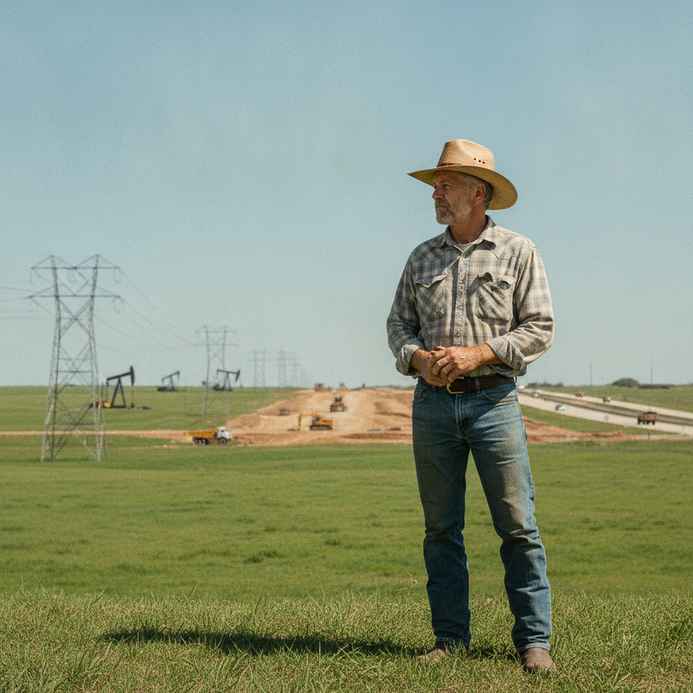
Let’s look at some common scenarios so you can see how these rules play out in real life.
-
A family farm lies in the path of a new state highway. TxDOT contacts the owners, negotiates, and eventually files a condemnation lawsuit when they can’t agree. The court sets the price, and the project moves forward.
-
A rural landowner gets a letter from a pipeline company about a natural gas line. The company has eminent domain power as a common carrier. After several rounds of negotiation, the landowner hires an attorney and gets a higher offer before agreeing to the sale.
-
A city wants to build a new park and contacts several homeowners. Most agree to sell, but one owner holds out. The city starts the eminent domain process, and a court decides the final payment.
[Inline Image Placeholder]
Alt text: A Texas landowner stands at the edge of a green field, surveying power lines and a distant highway construction site, symbolizing the impact of eminent domain on private property.
AI image prompt: A middle-aged man in jeans and a hat stands on the boundary of his Texas pasture, looking toward a construction site with power lines and earth-moving equipment, clear blue sky above, capturing the experience of landowners facing eminent domain.
Conclusion
Understanding who has eminent domain power in Texas helps you know what to expect if your property is targeted for a public project. From state agencies to utility companies, several entities can use this authority, but they must follow strict rules designed to protect your rights. If you want to learn more about your options or the process, contact us to learn more.